

October 26, 2023
Bullying in schools can put tremendous pressure on students to conform. Social conformity has been described as “…a type of social influence involving a change in belief or behavior in order to fit in with a group” (Spark, 2020). Statistics from PACER’s National Bullying Prevention Center show that 49.8% of tweens (9 to 12 years old) said they experienced bullying at school and 14.5% of tweens shared they experienced bullying online (Patchin & Hinduja, 2020). Research by Davis & Nixon showed that the support from peers who were bystanders was the most helpful to students who were being bullied. When we examine the power of social conformity it is a great credit to our students who buck this natural reaction to group behavior and step in as allies to help students who are being bullied.
Experiments on social conformity were conducted in the 1950’s by Solomon Asch. These were ground-breaking but the research is considered to be ethically questionable. There was criticism of the methodology due to bias and deception as the participants (all male), thought that they were taking part in a line test and not an experiment on conformity; however, this was necessary for the experiment’s results to be accurate. The Waiting Room experiment (2018) investigated social conformity and also included an unsuspecting participant, in this case, a young woman who thought she was coming in for a free eye test. The participant noticed that everyone else (the actors) in the room sat up every time there was a beeping sound. After three beeps, without even knowing why, she also stood up. Even when the original group of people left and no one was watching, the young woman continued to stand up. As other (unsuspecting participants) entered the room, they too conformed to this behavior (Brain Games, National Geographic). Jonah Berger from the University of Pennsylvania explains ‘herd behavior’, social learning that starts very early for developing conformity so we do not feel excluded.
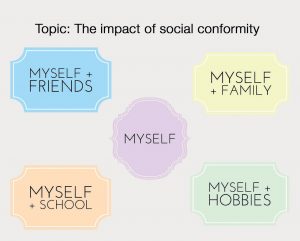
Exclusion and isolation can lead to psychological conflict as well as cognitive dissonance. The latter refers to a phenomenon where information that conflicts with our existing attitudes, values, and beliefs creates mental stress. Strategies to reduce this conflict include ignoring the information and changing the behavior. One of the ways we can support students’ combat cognitive dissonance and develop independent thinking, is by using the Myself Toolⓒ. This encourages students to reflect on the people and situations that influence them, and how these impact their behavior and sense of identity. Teachers can use the Myself Toolⓒ to support students in navigating the complex and often challenging expectations made on them by their friends, family, school, and engagement with out-of-school activities and hobbies.
Social conformity and ‘groupthink’ can affect what we believe and how we behave. It is confronting for educators to try and justify choices played out not only on the personal and local but also the global scale, to their students. For example, many schools and teachers in Australia are struggling to explain to their students why a proposed referendum that gives Indigenous and Torres Strait Islanders the constitutional enshrinement of a Voice to Parliament was resoundingly rejected by the nation. Fear of change and believing in misinformation, disinformation, and lies advocated by some politicians has resulted in yet another huge failure to bring noticeable outcomes to improve the lives of First Nations peoples. Many educators in Australia feel sad that young people have been exposed to racist attacks in the media. Has Australia suffered from a major case of cognitive dissonance?
Conversations you have with your students regarding issues such as this could include the following questions: Why do people behave in certain ways? Why do people not fact-check? Why do people believe what they are told on social media? As bystanders we stand by but what will it take for us to withstand, and stand with someone?
References
Cornell University. (2019, December 4). Social experiment: Information cascade. https://blogs.cornell.edu/info2040/2019/12/04/social-experiment-information-cascade/
Games, B. (2017, March 15). Brain games peer pressure part 01.mkv [Video]. YouTube. https://www.youtube.com/watch?v=QV5r_z-6uOw
Games, B. (2017, March 15). Brain games peer pressure part 02.mkv [Video]. YouTube. https://www.youtube.com/watch?v=ZOlYpm3e1fQ
Mcleod, S. (2023, August 2). Solomon Asch conformity line experiment study. Simply psychology.org. Retrieved October 18, 2023, from https://www.simplypsychology.org/asch-conformity.html
PACER’s National Bullying Prevention Center (Ed.). (2020, November). Bullying statistics: By the numbers. Pacer.org. Retrieved October 18, 2023, from https://www.pacer.org/bullying/info/stats.asp
Spark (Ed.). (2020, May 11). What is social conformity? Spark emotions. Retrieved October 18, 2023, from https://sparkemotions.com/2020/05/11/what-is-social-conformity/.Spark (Ed.). (2020, November 11). What is cognitive dissonance? Spark emotion. Retrieved October 18, 2023, from https://sparkemotions.com/2020/11/11/what-is-cognitive-dissonance/
You may also be interested in reading more articles written by Harbord & Khan for Intrepid Ed News.