
November 20, 2023
Last week in the beating heart of Silicon Valley, where humanity is not short of messiahs, a very human story started with independent school parallels and emerging impacts—one that is still unfolding. A deep dive into the tensions that have led to this schism is necessary for independent schools before they consider large scale changes to their curriculum and program around a technology that is still far from being a sustainable and usable product.
The tension at OpenAI ironically mirrors the tension we see at independent schools: our schools are non-profit organizations essentially running a product-based business (a school with enrollment and a range of services) but at the same time often aspiring to a higher future-focused purpose (a mission) that might require greater investment, research, and development. In both circumstances the conflict is real; the demands on resources equally acute; the access or availability of computing or cognitive capacity for growth similarly limited: and the effects on humanity also at stake, albeit in different ways.
The non-profit Board of OpenAI, which controls the for-profit subsidiary responsible for ChatGPT (see chart below), fired its CEO Sam Altman. Details are sketchy but it seems that at the root of the schism is misalignment and a fork in the road.
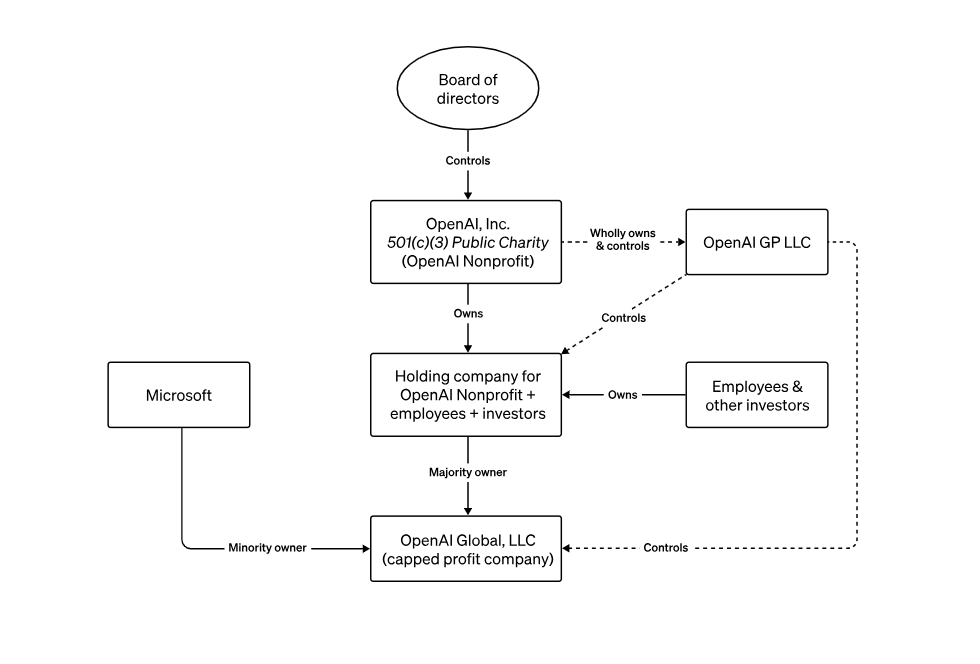
The for-profit OpenAI Global LLC has a very clear objective: profit (even if it’s capped to a level that sends surpluses to the non-profit). It is therefore product-focused (products that, at this point, are based on Large Language Models [LLM] like ChatGPT-4 and ChatGPT-5, and a GPT “app” store for others to build their own chatbots using the company’s LLM). It seems that some product-development plans had not been shared with the Board, at least not on a “consistently candid” basis.
The non-profit, however, has a mission, not a profit motive, and a constituency (humanity), not a shareholder base: “OpenAI is an AI research and development [my emphasis] company. Our mission is to ensure that artificial general intelligence (AGI) benefits all of humanity.” It is an R&D company, not a product company. However, the R&D company developing AGI needs access to massive amounts of expensive computing power just as the product company does to make ChatGPT-5 better than ChatGPT-4. So which is it that should be the focus? The product that can improve LLM and ChatGPT, or the research and development that can create AGI? Fundamentally, this looks like a problem of priority, or what we might call managerial alignment.
But another kind of alignment or misalignment is also at play, one that is existential. Just this July, OpenAI created a “Superalignment” initiative that would have access to 20% of all computing power that the company had secured. This initiative is led by one of OpenAI’s co-founders, Ilya Sutskever, who is thought to have engineered the firing of Sam Altman from the non-profit board. Super alignment is not about the tension between product and R&D. It is how artificial general intelligence can be controlled once it is developed and does not “go rogue.” Here is how OpenAI describes the issue:
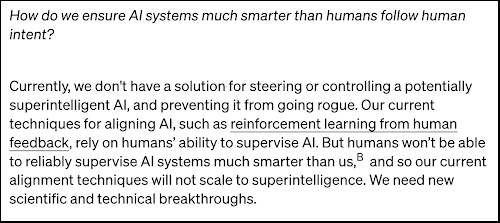
This statement shows the enormous computing and scaling differences between Language Learning Models that can benefit from or even require human supervision and input, and the AGI models that might not. AGI might well be capable of greater agency and so greater misalignment with humanity. AGI would tend to be superintelligent and must therefore be scaled with “superalignment” processes. The differences make LLMs look decidedly pedestrian.
Before institutions start to rebuild their whole education model — as the International Baccalaureate seemed ready to do by downgrading essay writing as a skill earlier this year (see The IB reaches for the Self-Destruct Button) — consider that there is now growing skepticism that LLMs are the future. In a recent interview in a German newspaper, Bill Gates said that he did not believe GPT-5 would surpass its predecessor. A leading Meta AI executive has said that LLMs may not be the route to AGI and may even be “an off-ramp” on the way to AGI. By “off-ramp” what is probably meant is a great commercialization opportunity but ultimately a distraction from the eventual dream. Close but no cigar.
The current schism at OpenAI now seems to bring this issue into focus. If LLMs get abandoned, downgraded, or commoditized on the route to AGI, all users must ask themselves at what point (if ever) LLMs will get to a level of comfort as a human competitive product, and whether the expense of keeping LLMs up to date will make it a viable tool around which schools should build their futures. “According to my last knowledge update in 2022”, ChatPGT-4’s current default disclaimer, may not long cut it. There are lots of usable products that become too expensive to run: planes, cars, and even schools can be found in that bracket. LLMs like ChatGPT may well lose their appeal as an enabling invention on the product development pathway of a more important, mission-driven, human-competitive product.
In the case of OpenAI, it would appear that the non-profit Board took the hard decisions on alignment and mission priority that few schools have been able to make. A debate about when to abandon or downgrade a product is one that takes great skill, courage, and strategic thinking. It takes finding an incremental route that aligns future needs with current capacity. It is much easier to scale outcome-deficient but nevertheless marketable solutions. It is the instinct that has doomed so many scale-obsessed education ventures in Silicon Valley. It is the same instinct that schools have taken in programmatic add-ons or “off-ramps” instead of integrated future-focused offerings.
Over the next few weeks and months, we are likely to find out whether the Board of the non-profit OpenAI has come to the conclusion that LLMs were a false dawn in the more important life cycle of an artificial general intelligence product. It is starting to look that way to me. It might then be too early to dispense with essay writing as a skill per the IB. It also may be time to reconsider the recently appearing job positions for Directors of Teaching & Learning for AI, or the AI Literacy courses. We seem to have just emerged from the euphoria stage of a new technology horizon to the early reality phase, and we might be here quite a while.
You may also be interested in reading more articles written by Sanje Ratnavale for Intrepid Ed News.