

June 19, 2023
It was the third sunny day in May after weeks of dreadful rain. Looking longingly out of my office window in the nearly empty school building, I promised myself a long walk with my dog after the webinar. I returned my attention to the screen. To me, this webinar on the little-known topic of “Japanese Latin Americans & U.S. WWII Incarceration: Accountability and Redress” was most important, so I decided to jump in at the deep end by attending it.
Three prominent advocates and experts in the field were on the panel. Dr. Natasha Sugiyama, the panel’s moderator, is also the first person who educated me on the topic and introduced the panelists. Dr. Stephanie Moore spoke next and presented the historical background of Japanese immigration to Latin America between the early 1800s to the mid-19th century. Grace Shimizu was the third person to speak. She shared the decades-long frustrating journey of the Campaign for Justice: Redress NOW for Japanese Latin Americans. As I was listening, cold sweat covered my palms and my chest started to hurt. Words completely escaped me. There was so much I did not know. The rest of the world knows even less, which really saddened me.
Only two months ago, I first heard about incarcerated Japanese Latin Americans during WWII. 2,264 of them from 13 different Latin American countries were abducted from their homes or businesses. The U.S. planned to use them for hostage exchange with Japan. They were incarcerated in the Crystal City Department of Justice Internment Camp in Texas. 800 of them were actually used as hostages. Once they left Peru for this camp, their families never saw them again. After the war ended, most of the internees were deported to war-devastated Japan because the U.S. assigned them “illegal entry” upon their arrival.
This hard fact of history did not seem real to me: ordinary people lost their fundamental human rights in violent ways. It felt like watching a horror movie in which roaming gangsters controlled the world. More than three-quarters of a century later, gangsters are still in denial of their wrongdoing and refuse to acknowledge the truth. Except, the human rights destroyers are not gangsters. They represent the self-claimed “guardian of world peace”—the United States of America.
Since U.S. history has often overlooked or excluded Asian American experiences, fewer than 10% of the general public is aware of the experiences of Japanese descendants in the U.S. during WWII. The U.S. declared war on Japan on the day after the Pearl Harbor bombing. Within weeks, 120,000 Japanese Americans and legal residents of Japanese descent along the west coast were forcefully removed from their homes. Their business, farms, fishing boats, houses, and possessions were liquidated. Their bank accounts were frozen. From infants to aging elders, all were uprooted from their lives, without any due process. They were put on a train, a bus, or a boat and transported to unknown and desolate places. The well-known Star Trek actor, George Takei, was only five years old when it happened to his family. His sister was an infant, and his brother Henry was only 3 years old.
As George Takei recounts in his book, They Called Us Enemy, his family was only allowed to take what they could carry in their hands. Takei’s family was assigned a horse stall at the Santa Anita Racetrack, a temporary WCCA camp, to sleep during the first few weeks of their incarceration. Being young children, both Takei brothers thought it was the coolest experience to sleep with horses. They were too young to grasp their parents’ despair and the severity of the situation they were in. Four years later, when the incarceration camps were dissolved, internees were handed a bus ticket, $25, and told to leave. In the midst of confusion and chaos, with nowhere to go, Takei’s sister cried of “wanting to go home,” a.k.a. the incarceration camp at Tule Lake, as that was the only place she knew as “home.”
Takei’s family story as an example of the Japanese American experience during WWII is better known. However, the Japanese-Latin American story is more like a hidden secret in bright daylight. One such example is the Kudo family story.
Elsa Kudo was 7 years old when disaster suddenly struck her family in Peru. Her father had immigrated there when he was 17 years old. Being an extremely smart, capable, and hard-working entrepreneur, he created a successful textile company. Soon he became a symbol of one of the prominent Japanese Peruvians in the Ica. Elsa said during her first 7 years of life, all she knew was bliss. Her mom was born in Peru and therefore fluent in Spanish. She ran the family storefront while her father stayed behind the curtain to take care of the children and handled big decisions for the company. They had two full-time nannies and a chauffeur as well and lived in an affluent community.
Then, the Peruvian government accepted the American military aid deal. In exchange, they helped the U.S. abduct Japanese Peruvians and liquidate their businesses, homes, and possessions. Similar to what happened to Japanese Americans, without any due process, 1800 Japanese Peruvians were deported to the U.S. Unfortunately, Elsa’s family was one of them.
From Elsa’s family’s point of view, they only know the Peruvian military began a manhunt. Elsa’s father refused to leave his five young children and wife. So, he dug a hole under a bed and stayed hidden for over a year. After a year, they became less vigilant. Then one night, the family heard a knock at the door. A young apprentice opened the door without thinking. Five detectives were at the door and took her father. Their family was having dinner. Her father asked to finish his last supper with the family. At the same time, her mother quickly packed a bag for him to take. Then he was gone. Nobody knew where he was taken. After eight months of long painful waiting, they were informed that they all had to board a ship bound for the U.S. to reunite with the father.
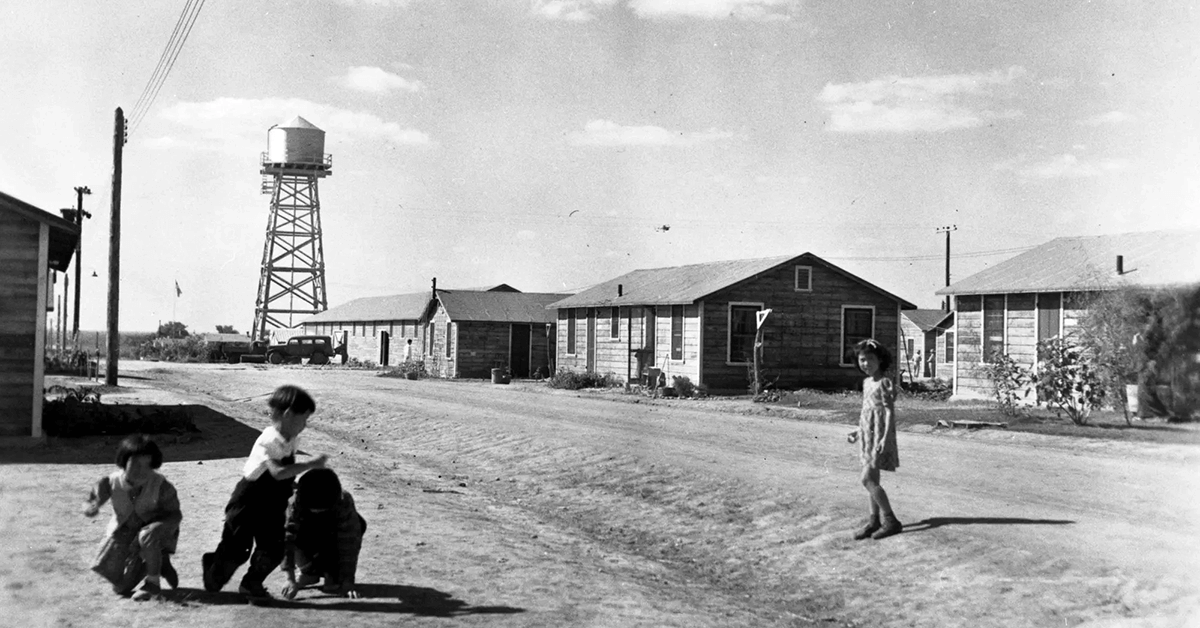
Cramped in a narrow, dark, and hot room, the lights and windows were shut at all times. Elsa and her family endured a 3-week boat ride to the camp. After she got off the bus, she was stunned to find she was standing in front of a desolate, dusty, barbed wire place, surrounded by a deep ditch that was filled with murky water. Elsa’s family had arrived at the Crystal City Department of Justice Internment camp in Texas.
As a 7-year-old, the joy of reuniting with her father overpowered all the hardship ahead. In the crowded camp, at first, their life was quite segregated due to the language barriers. Eventually, some Japanese Americans volunteered to teach them English. They began to learn their ABCs while longing to go back home soon.
When WWII came to an end, people around the world celebrated hard-fought freedom and liberty. However, Japanese Latin Americans’ hopes of returning home were shattered. Little did they know that the U.S. government had destroyed all of their legal documentation. With the designation of “illegal entry” upon their arrival, they became stateless overnight. The Peruvian government refused to take them back. Japan denied them as Japanese citizens. The U.S. once again had the upper hand and shipped hundreds of Japanese Latin Americans to Japan. For nearly all of them, they never regained their wealth and health. “The U.S. also robbed my grandfather’s spirit away,” Art Shibayama’s daughter testified in front of the Inter-American Commission on Human Rights (IACHR) during the public hearing of the Shibayama, et al. v. USA petition.
Elsa’s family was one of fewer than 300 Japanese Peruvians who refused to sign the papers to be shipped to Hiroshima. A lawyer from the American Civil Liberty Union (ACLU) fought on their behalf and argued that these Peruvians should be allowed to stay in the U.S. When the Seabrook canning factory, which faced a labor shortage after WWII, offered to sponsor Elsa Kudo’s family, they moved to New Jersey. It would take decades for many Japanese Latin Americans to adjust their immigration status and eventually be permitted to become naturalized U.S. citizens. However, the fight for the U.S. to acknowledge American violation of Japanese Latin Americans’ basic human rights has been long and continues today. While it is important to know the Kudo family story, it is only a drop in the vast ocean of devastation.
In 1989, President Regan formally apologized to Japanese Americans and offered symbolic financial compensation to the remaining 8000 surviving internees. Unthinkably, Japanese Latin Americans (JLA) were not included. The reason given was that they did not have U.S. citizenship during the WWII period.
In 2003, three former Japanese Peruvian internees—the Shibayama brothers—filed their petition with IACHR. After 13 years of waiting and when two of the three brothers were diagnosed with dementia, the Shibayama case was finally given a public hearing at the IACHR on March 21, 2017. Notably, the U.S. government did not even show up to defend its actions. 86-year-old Isamu Carlos Shibayama was the only brother present to testify. The IACHR concluded that the USA was responsible for the violation of Japanese Latin Americans’ fundamental human rights. It recommended that the U.S. provide reparation and ensure full disclosure of government information relating to the program of deportation and internment of JLAs during WWII.
But the U.S. still needs to show true courage to right this wrong. Today, advocates from all over the U.S. are fighting for Japanese Latin Americans’ redress. As Isamu Carlos Shibayama concluded during his testimony: the reason he and his brothers kept on fighting was their deep belief in democracy and hope to prevent a similar experience from happening to other people of different skin color. During the Webinar’s Q&A session, I made a surprising discovery. The very person, Elsa Kudo, whom I researched and wrote about was attending the webinar with her daughter. Now, well into her 80s, Elsa and many other advocates work together on the Campaign for Justice. They wish to spread awareness to the general public, so our country and people can learn from our painful past and not repeat these mistakes in the future. George Takei once said that we should all stop being passive in our effort to make the world a better place. Now the time is urgent as there are not many former internees that are still alive. Let’s all take action: look up your legislators, pick up the phone, or write an email to magnify the voice and visibility of Asian Americans and Japanese Latin Americans.
You may also be interested in reading more articles written by Haiyun Lu for Intrepid Ed News.