

July 11, 2023
I asked ChatGPT to give me a list of well-known American artists. From Jackson Pollock to Robert Rauschenberg, not a single Asian American artist made it onto the list. I’m not surprised since the majority of Americans cannot name more than five Asian Americans in general. If the most resourceful ChatGPT yields biased information, then something is seriously wrong.
This void has truly proven that an expert series’ talk cosponsored by Nō Studios and Milwaukee Art Museum is extremely valuable. The panel discussion I participated in was a dialogue between American’s well-known filmmaker and screenwriter, John Ridley, and the late American artist Chiura Obata’s granddaughter and author, Kimi Hill, on Chiura Obata’s life and contributions.
During a time when division, mistrust, the lack of tolerance, and unwillingness to compromise dominate our culture, media, and society, a discussion like this is critically important in fostering understanding, empathy, collaboration, and acceptance in our country.
Born in 1885 in Okayama, Japan, Obata had love, passion, and appreciation for art and nature from a very young age. When he was 14 years old, he left home, went to Tokyo, and became an art apprentice to learn traditional Japanese painting and Western-Style art. Remarkably, by the time he reached 17 years old, he had already begun supporting himself through his artistic endeavors.
Obata dreamed of going to the art capital of Paris and leaving his mark there. However, his parents were poor farmers who struggled daily to get enough food on the table. Studying art was a luxurious pursuit. Therefore, as the only son in the family, Obata thought he would go to America to seek his fortune first before setting sail for Paris. In 1903, he arrived in San Francisco’s Japan Town. He was determined to make the U.S. his launch pad into the glamorous artistic world.
Therefore, the initial language barriers and financial hardship did not deter him. Working as a janitor and a houseboy for affluent white families, Obata squeezed out every penny he could from his meager earning for his dream. Whenever he had a brief moment of free time, he would draw. His passion for art propelled him through scary darkness and unbearable loneliness.
In 1912, Obata met the love of his life, Haruko. They fell deeply in love, and Obata expressed his desire to take her to live in Paris if she married him. However, their plans took a different turn when Haruko became pregnant. Their life’s trajectory was altered, and as Kimi Hill, Obata’s granddaughter, recalled her grandmother saying, “He never took me to Paris! Not even once!” One can’t help but wonder if the Japanese American incarceration during World War II had not occurred, would Obata have fulfilled his promise to take his wife to Paris at least once?
Despite having to let go of his dream of Paris, Obata’s exceptional talent and unwavering passion drew the admiration of the Western art community in San Francisco. As a result, he received an opportunity to teach at the University of California (UC), Berkeley.
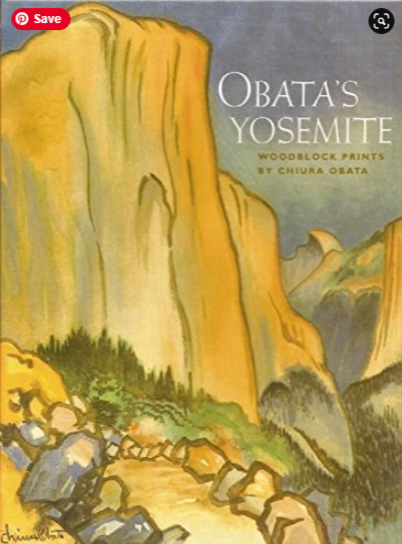
Obata was a prolific artist known for his signature vibrant landscapes. His artworks reflected how much he loved nature and his skill in capturing the feeling and soul of the landscapes he saw. Obata told Kimi that hiking in nature was an exercise for the eyes. Yosemite National Park called upon him countless times. He also believed that college art students should not graduate without being trained in discovering the beauty of nature and developing their eye for it.
Obata’s brushwork is marked by a harmonious blend of precision and expressiveness. The root of his technique can be traced back to 1000 BC China. His mastery of color allowed him to evoke the changing moods of the landscapes and invite viewers to pause, reflect, and appreciate the beauty and power of nature.
His early works often incorporate elements of balance and harmony. Viewers are drawn in to experience a moment of contemplation and connection with nature through either vibrant blooming flowers, a tranquil lake, a misty morning, a silent mountain, or a fiery sunset.
However, when the forced removal was executed in 1942, Obata’s landscape paintings absorbed the disastrous political force and became an abstraction of the tormented world both within and outside. For example, in his “Landslide,” he depicts a vortex of unstoppable destruction for which nobody could be prepared. Staring at the painting, I felt confused, lost, and a sense of horror rising from within.
Kimi Hill repeatedly said that her family was extremely fortunate. As most Japanese American families lost pretty much everything during the incarceration, UC Berkeley President Robert Gordon Sproul, recognizing the artistic and cultural value of Obata’s work, made a special arrangement to store his works. “My grandfather has been very grateful. His country might have forsaken him, but he never felt that he was abandoned by his people,” Kimi added during the talk.
That speaks to the truth of Obata’s extraordinary character. That was why, in less than a month, when he lived in a horse stall at the Tanforan Assembly Center in San Bruno, California (a temporary holding facility before being transferred to a more permanent camp), he recruited 16 art teachers and funded an art school to provide a glimpse of hope and normalcy to the internees. “He sensed that the resentment and anger were very high, and with nothing to do, bad things were inevitably bound to happen. So, he had to do something. That was art,” Kimi added.
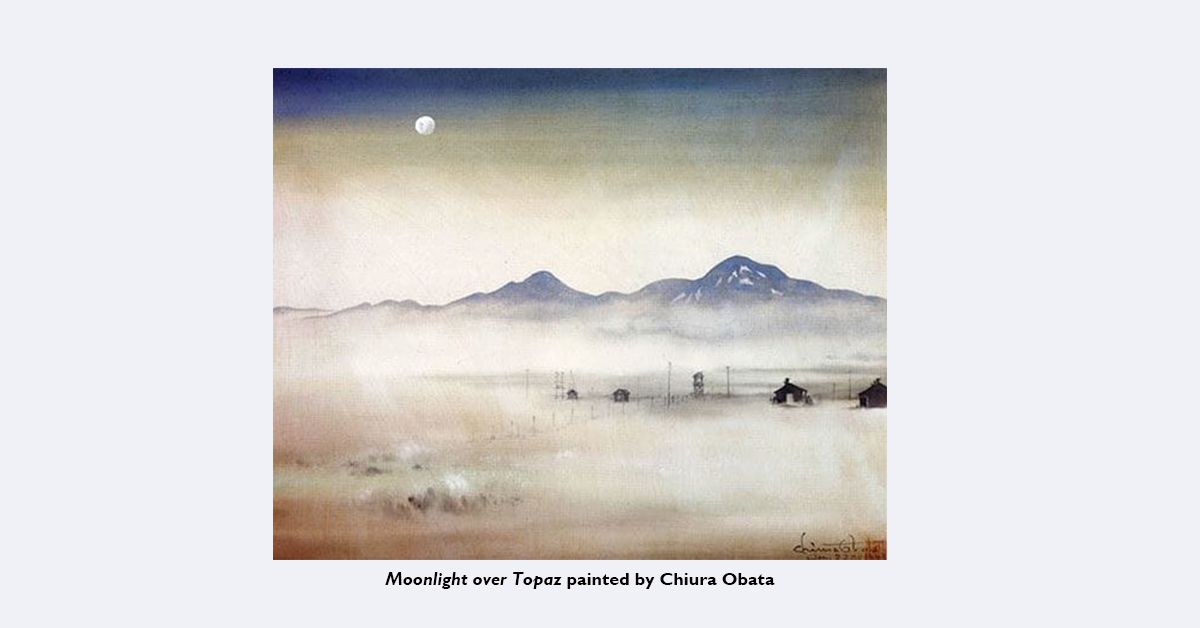
A few months later, when his family was relocated to Topaz, Utah, one of the most desolate incarceration camps in the country, Obata started a new art school along with 10 other volunteers. They had students ranging from little kids to elderly men, and nearly 700 students took classes from them weekly. In addition to offering three traditional categories of art classes in fine arts, commercial arts, and techniques, they also provided sewing, knitting, and wood blocking, among others, at the camp. “The full range of it, you know, people have different interests and talents,” Kimi explained with a smile.
Now let’s pause right here. Imagine a desert region in Utah. Dust and extreme temperature fluctuations were the most intimate companions. The incarceration camp was constructed on barren land, surrounded by barbed wire fences and guard towers.
The barracks in which internees lived were typically divided into several units, each accommodating multiple families. The spaces were small and lacked privacy, with communal facilities such as mess halls, bathrooms, and laundry areas.
That was the condition in which 120,000 Japanese Americans were placed during WWII. In such an inhuman place, what does it take for one to have faith and passion in preserving hope, integrity, self-respect, and love?
As I’m writing here, John Ridley’s words echo in my ears. Born and raised in Milwaukee, he built a reputation in Hollywood as a filmmaker and screenwriter. After living in Los Angeles for 30 years, his eyes turned back to Milwaukee. “This is too good of a city to be left behind,” he pleads. Once a prosperous harbor city serving as a vital economic force in the country, in recent decades, Milwaukee has become one of the most segregated cities in the country. It has one of the highest incarceration rates for black males between the ages of 18 and 35. “I want to do something that can bring people together and elicit joy and laughter from each one. That is art.” Hence, Nō Studios was born.
After WWII was over, Obata was reinstated as an art professor at UC Berkeley. This is another fortunate thing that Kimi kept mentioning, how lucky they had been. Obata continued teaching for another decade and painting until the very end stage of his life.
Today, Chiura Obata’s works have been displayed in various prestigious institutions and museums around the world, including the Smithsonian American Art Museum in Washington, D.C., and the Fine Arts Museums of San Francisco, just to name a few.
As the U.S. becomes a more accepting and harmonious country, more people will become acquainted with Obata’s work and follow in his footsteps to promote peace, dignity, and humanity in the most challenging times and places.
I hope that museums worldwide will exhibit Obata’s works, including the Milwaukee Art Museum in my home state. I envision a future where we can all simply identify as “Americans.” Just as European immigrants seamlessly integrated into American society, I wish for the day when people of different skin colors and ethnicities can do the same without raising an eyebrow or harboring doubts. Ultimately, we are all human beings who bask under the same sun.
You may also be interested in reading more articles written by Haiyun Lu for Intrepid Ed News.