
January 8, 2024
Thinking of writing a book? Our current book, 21 Visual Thinking Tools for the Classroom: Developing Real-World Problem Solvers in Grades 5-10, is designed to specifically help students with their engagement and problem-solving and will be published by Routledge next summer. Having just submitted our manuscript to our publisher, we wanted to share our experiences.
A for Anticipate
When we were in schools after the pandemic it was clear that they were dealing with many new social and emotional issues (the impacts of which are still to be fully understood). We anticipated that teachers would need different ways to support students, and believed our thinking tools, such as The Thinking Generator Toolⓒ and the Knowledge Twister Toolⓒ could help. Our belief was validated from the responses from principals, teachers and students.
W is for Why
Why do you want to write this particular book? You need to be clear about ‘why’, in order to work out the ‘how’ and not give up. Through our teaching experience we knew we had a concept that could help move educators to focus on metacognition and ethical issues could change students’ learning experiences; away from content towards creativity and innovative thinking. OECD (Organisation for Economic Co-operation and Development) tells us we need to be educating our students for an unknown future where they need creative and critical thinkers.
O for Opportunity
Look for opportunities to generate your ideas, and writing about what you know is always good advice. So look at your daily teaching practice and evaluate it in a way that is meaningful for your and your students’ growth. Keep your eye on real-world issues for inspiration as well, and find a new idea or concept that supports student learning and engagement.
M is for Making Connections
Through a workshop we did in Seoul, a colleague was able to get us an introduction to an educational publisher in the U.K. John Catt (now Hodder) published our first two books, but when our third book was rejected, this editor gave us an introduction to Routledge U.S. Obviously our work had to speak for itself, but we were lucky, and also persistent. When we had one proposal rejected we immediately emailed the editor with three other ideas. Happenstance, they liked all three and told us to develop any of these ideas.
U for Usable & User
Who is your audience? Who are you writing for? Our idea with this book was to make a resource that teachers could simply slot into their classes without having to re-work their lesson and unit plans. We wanted a resource that could work for most subject areas and a vast range of year levels and any curriculum (Common Core, American International Curriculum, International Baccalaureate, National Curriculum for England, Australian Curriculum, American International Curriculum and Canadian Curriculum).
I is for Innovative
How is your book different from what is on the market? Our first and second books were innovative because we used ethical dilemmas to drive student inquiry through interdisciplinary units of work. Our third book is also unique because we created our own visual thinking tools. Be aware of trends in education so you can be ahead of them.
C is for Collaboration
Writing together is a powerful collaboration as we springboard ideas. Sometimes we have different viewpoints, but philosophically we are always on the same page. Living in different parts of the world also gives us a more global view. Our initial ideas continually develop and change through our discussions.This is a strength of our work, in that we are flexible and open to change. Some may work in a more linear way but we don’t.
P is for Plan B
Have a back up plan in mind as you work on your idea, so if you are rejected you can bounce back with another option and are not starting from scratch.
B is for Book Proposal
This is like writing the book itself and takes considerable time. It tests you, to test your idea with tasks such as writing a blurb within a certain word count. That’s tough writing: you have to crystallize your idea and sell it. You finally finish your book proposal and then the waiting starts.
The original blurb describing our first book (published in 2020) in 100 words or less, was as follows:
‘Design Thinking for Schools: Ethics, Emotions and Creativity’ is laid out by two experienced design teachers with a combined forty years of experience in curriculum writing and design teaching. By being an interdisciplinary book that tackles design as a subset of maths, art, english, science and technology, it is applicable to multiple classrooms in multiple frameworks to develop twenty-first century skills, and is a useful tool for any middle school teacher. This means that the book is a complete module that can be picked up and taught by a teacher with any level of experience, and is a great resource for both experienced teachers and substitutes who aren’t sure what to tackle in class today.
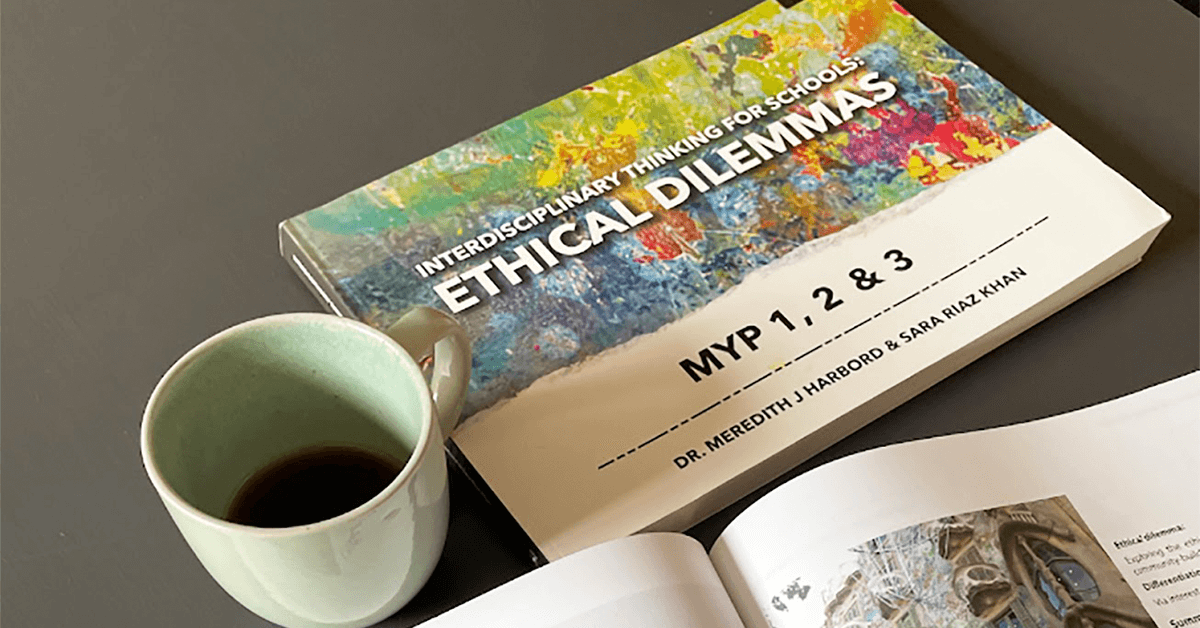
This was the final blurb (along with the name change) for ‘Interdisciplinary Thinking for Schools: Ethical Dilemmas MYP 1, 2, & 3’:
Interdisciplinary Thinking for Schools: Ethical Dilemmas MYP 1,2,&3 is not your average textbook resource. Innovative ethical design projects illustrated with spectacular artwork will connect students to exciting and purposeful learning. Rich primary research includes interviews with the following visionaries: Alberto Alessi, Astronomer Royal Martin Rees, Dr. Jane Goodall, Jared Della Valle and the Stephanie Alexander Kitchen Garden Foundation.
The interdisciplinary units have been written with a focus on creativity, critical thinking and exploration of embedded ethical dilemmas. Our strategies support the growth of an innovative and student-centered curriculum to generate real world, sustainable solutions to problems in keeping with the IB Middle Years Programme philosophy.
T is for Testing
Feedback from others and testing of your idea is essential as a fresh pair of eyes might see something you have missed. School testing of our tools was invaluable, as the results confirmed that the instructions were easily understood, and the content back from the students showed that our tools were supporting them in critical thinking and problem-solving.
They also showed us that a few needed adaptation for the classroom. We approached teachers and schools all over the world to test our tools and give us feedback for improvement. We had teachers who were excited to trial these and we were excited to see the results.
D is for Documentation
Be prepared for the amount of paperwork that goes into publishing a book, apart from the writing of the book itself; from the proposal, to sending out consent forms and getting approvals, approaching and interviewing people for content, preparing captions and alt text, writing chapter summaries and a table of contents and, of course, revisions from your editor.
C is for Contract
After your idea is approved, you sign your contract. It’s very important to look closely at what you are agreeing to, e.g. we agreed to a manuscript of 45,000 words in four months as well as all the other supporting documentation. When you are planning a book it is essential to meet your publisher’s timeline and we almost did, but needed 4 extra days to receive back one school’s content. However well you plan, the unexpected happens so, as much as you can, plan for this also.
E is for Efficiency
How can one project help you with another and make you more efficient with deadlines? Since 2020 we have been writing for Intrepid Ed News, and this has helped us hone our writing skills. The short term goal of an article a month has had a compounded effect of writing the whole book. Focusing on our own work as well as writing articles for Intrepid ED News meant that our collection of thinking tools kept growing to the point where we had enough for a whole book.
R is for Resilience
Resilience would be a great description for what one needs as you start a project to write a book. With our book ’21 Visual Thinking Tools for the Classroom: Developing Real-World Problem Solvers in Grades 5-10’ we had a vision of what we wanted to create. A book that would work in any school with any curriculum and actually help both the educators and students who are having issues that do not fall naturally into the standardized curriculum that they are required to teach and learn from.
Don’t let your inner critic sabotage you and keep going. Stick to your resolve and don’t take rejection personally. There were some publishers we didn’t hear back from at all, and our initial proposal to Routledge was rejected. Basketball coach and former Olympian Dawn Staley’s rules for life and personal motto, “What Is Delayed Is Not Denied” is worth keeping in mind.
“The execution and hard work and the preparation, you can’t speed it up, you can’t slow it down. But if you’re able to be patient, you’re going to be successful.” [1](https://blume.vc/commentaries/the-playbook-episode-5-dawn-staley-a-coachs-rules-for-life)
Life doesn’t stop because you have a book to write and are committed to a deadline. Between the two of us, we have faced multiple challenges as we wrote the book. Showing up for each other and for ourselves made all the difference. If you don’t keep trying you have zero chance of success. We wish you good luck!
You may also be interested in reading more articles written by Harbord & Khan for Intrepid Ed News.
Footnotes