
November 13, 2023
[Second in a series: Beyond PBL; go to Part 1]
In case you missed it, fungi are pretty smart. Research reveals fungi, like mushrooms, as being closer to animals than plants. Fungal mycelia—the underground network we can’t see—show decision-making and alter their developmental patterns in response to interactions with other organisms. Mycelia may even be capable of spatial recognition and learning coupled with a facility for short-term memory.
Since we share almost 50% of our DNA with mushrooms, I consider that good news for humans.
It might also be a clue to the most radical change educators can make: To stop relying on the brain alone to explain intelligence. Intelligence is still a deep mystery to science, but our current view of ‘smart’ in education says it originates in a neural network composed of 86 billion neurons. It only happens inside us. Yet fungi tell us the opposite: Intelligence is communal and ecological, not individual. Since half of the 10 billion miles of DNA in our cells has a common ancestry, perhaps we should pay attention.
I’ve always taken the position that project-based learning is the ‘natural’ way to learn. PBL is a human design system that recreates the lifelong process of encountering challenges, grappling with problems, and sharing results. But if it’s as good as promised, as many educators feel, what’s the impediment to full-scale implementation?
The greatest barrier, in my mind, is clear: We’re stuck on a 500-year-old brain-centric version of intelligence. That embedded view has direct consequences for education. The assumption that knowledge is only found in individual brains leads to every ill of the modern system: The input-output metaphors that drive direct teaching, an overstuffed curriculum, and compliance to strict standards backed by tests measuring retention but not capability.
Twenty years ago educators came up with a fix for this gap: The now axiomatic 4 C’s. (Okay, I’ll list them, even though they’ve been burned into us: Critical thinking; Communication; Collaboration; and Creativity). Since PBL is designed to teach those exact skills, the list seemed a perfect fit. Up went the posters. Rubrics were written. Teachers even waded into grading the skills, a brave step in a conservative academic world.
It hasn’t worked, particularly in the Western standardized system. The 4 C’s list has remained a list, usually on the school website or otherwise tucked away out of mind. Again, the reason is clear: In a system focused on filling the mind, skills will always take second place, as does well-being and the time for relationships so critical to surfacing the strengths necessary to be skillful.
It’s impossible to translate our outdated version of intelligence into actions that are social and communal—at the exact time those actions are most needed. Nature seems to agree. She has issued a message to rethink intelligence as a connective enterprise. Fungi are a beautiful example, but chickadees, Orcas, octopus, and bees do the same. Forest bathing works because trees connect energetically to hormone production.
Science is working hard to keep up with the shift. Cultural social neuroscience shows how the brain is grounded in its social surroundings. In opposition to the idea that creativity is an inborn trait, creativity is now seen as a group skill. Neuroscientists have documented brain-to-brain communication. Evidence has emerged for global consciousness, which would be welcome to a planet crying out for an intelligent, holistic approach to saving itself. Even the hallowed Theory of Evolution, the foundation for individual intelligence, is on the verge of a radical makeover.
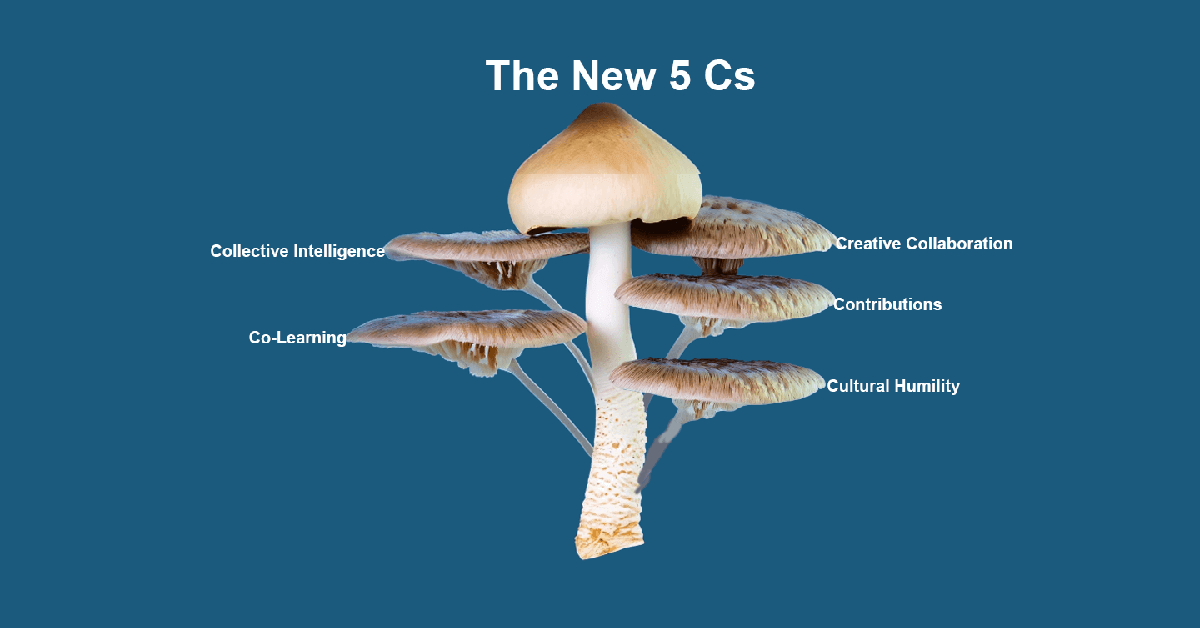
This points toward a new list of C’s that better match Nature and the times. I’ll offer a start with a draft list of Five C’s that follow Nature’s example by highlighting a social and networked form of learning, accomplishment, and exhibition of intelligence:
Collective intelligence. Have you worked with others in a way that facilitates both your learning and the learning of others? Can you identify areas of common growth? Do you know what you have learned from others?
Co-Learning. Have you practiced the relationship skills and openness necessary to learn from all sources of knowledge in your environment, including students, teachers, and colleagues?
Creative collaboration. Have you learned to work with others to analyze challenges in your environment and work with others on creative solutions? Are you able to step outside established boundaries of thought, connect with others, and form partnerships necessary for reinvention and innovation?
Contribution. Have you engaged your network in positive impact and contribution? To what extent is your social intelligence making a difference in the world?
Cultural humility. Have you demonstrated that you can work across all racial, ethnic, geographic, and cultural barriers to connect and engage in positive planetary progress?
These skills are the true ‘fit to purpose’ of PBL, but the provocation to reinvent intelligence will take us eventually on a deeper path. The future of learning is going to resemble those fungi. On a hike you see the cap, the visible fruit, but underneath is a huge invisible network reaching out to connect, learn, share, and support one another.
You may also be interested in reading more articles written by Thom Markham for Intrepid Ed News.