
June 27, 2023
Many young people have difficulty with their relationships with social media and ‘influencers’ that can sometimes overwhelm their lives.
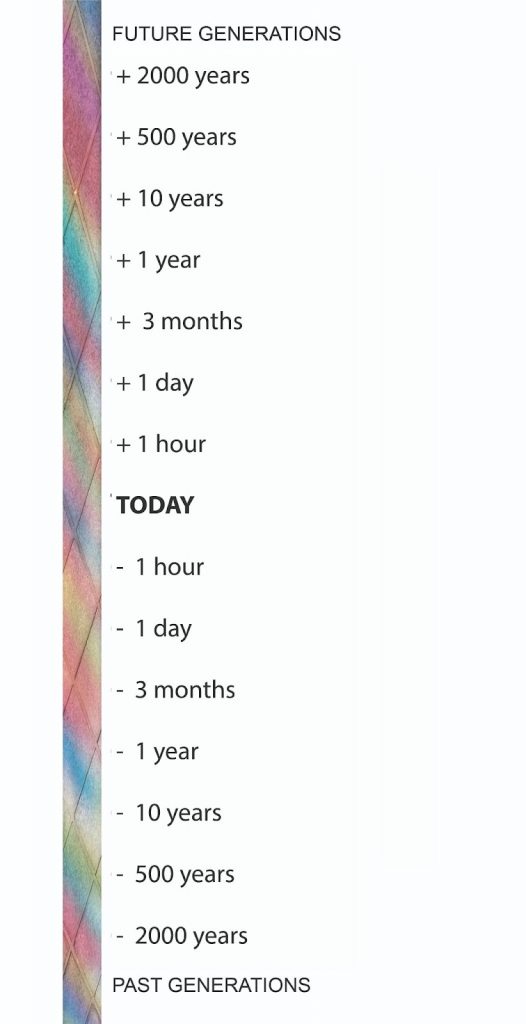
How can reflecting on different concepts of time contextualize students’ experiences in the bigger picture and make them feel like they belong to something larger than themselves? One strategy we can use to inspire students is the Timeline Toolⓒ, a visual thinking organizer. It was designed to encourage students to imagine different periods of time which have no relation to their own and reflect on learning from the past to build a better world. This process may enrich students’ understanding of the challenges of being empathic and caring for living things beyond their own timeframe. The benefit of exploring their own identity and behavior in different contexts, from what they can imagine and are comfortable with to what is unknown, is that it can help students develop a greater understanding of their place in their world at this time.
The Timeline Toolⓒ can help students think about time in critical, creative, and purposeful ways. By thinking deeply and working through the Timeline questions, students can indicate how clearly they can remember the past and imagine the future to consider the benefits of these scenarios.
Timeline Questions:
1. How clearly out of 10 can you remember what happened today? /10
2. Choose one past or negative (-) number e.g. -3 months and one future or positive (+) number e.g. +500 years.
How clearly out of 10, can you remember the past e.g. -3 months ago? /10
How clearly out of 10, can you imagine what the future will look like e.g. +500 years? /10
3. Give two (2) reasons why:
Reflecting on the past could help us and our world:
a)
b)
Imagining the future could help us and our world:
a)
b)
The Timeline Toolⓒ can be used by all teachers. For example, in P.E. students can reflect on how activity levels have dropped as a result of industrialization and technological advances to make workplace and recreational spaces more sedentary. They can imagine the impact of these factors on people’s health and fitness in the future and what should be changed to improve the situation. The Timeline Toolⓒ could also assist students in thinking about long-term fitness and health issues by plotting goals both for themselves and the wider community (Sean Blake, P.E. Teacher, 2023). Being proactive and taking responsibility for our health in the present affects our future, as what we do matters. If a student is very interested in playing with these timelines, as an extension activity they could try placing the different examples of the timeframes into a memory palace. Here they could imagine the different time frames into a series of rooms that are connected yet can stand alone.
An ancient perspective of time that has existed for thousands of years comes from the Aboriginal and Torres Strait Islanders in Australia. They have the oldest living culture in the world, currently estimated at 65,000 years. Their concept of time is quite different from the Judeo-Christian perception, which views time as exclusively ‘linear’ (i.e. past-present-future). Australian Indigenous cultures think of time as cyclical (a circular pattern of time not sequential). The Indigenous concept of “deep time” as explained by Yuwaalaraay/Gamilaraay woman Frances Peters Little (Visiting Research Fellow, UTS):
“All things will outlast us, the land will change, and survive … Yes, the land will be different. But new things will come of it”.
McGrath, 2020
Another concept of time is deep time. This was first described in 1788 by James Hutton (Scottish geologist), although only conceived as a term 200 years later, by the American author John McPhee (Thompson, 2014). As Helen Gordon writes,
“In deep time it is not just what happened last week or last year or last decade that matters – it’s also what happened a million, 50 million, 500 million years ago”.
Gordon, 2021, pp. 1-2
In his book, Otherlands, Michael Halliday describes and imagines life and living conditions from different epochs (Halliday, 2022). Impacted by factors such as shifting continents and mass extinctions, many of these environments were unrecognizable as the planet we know as our home. To realize how the human race has only been around for an instant in deep time and how we have impacted our world is worthy of conversation in the classroom. This does not mean that we do not matter, more that our choices do have an effect and we need to consider the long-term consequences of our actions. In education, a holistic, interdisciplinary approach can often give students a deeper understanding of their inquiry. There are rich opportunities for interdisciplinary curriculum through the lens of deep time in the areas of Engineering design (structures and technology), math (scale and ratio), and evolution and extinction in languages and natural sciences. These are just a few examples to consider.
Engaging student interest through new experiences is a well-known teaching strategy, as our brain responds to novel approaches. Thinking about deep time, indigenous perspectives, and time travel can be enriching and motivating. The process of jumping forward and backward in time can also give students the opportunity to examine how they or others may feel about being thrown into a different place and time and, in fact, result in an empathic reaction to this experience.
Michael Halliday commented that
“Answers to long-term questions can only be found by looking at the times in which the past Earth mirrors what we expect of future Earth”.
Halliday, p.xv. 2022
| Who we were and how we acted in the past may give us insights about how we may or may not choose to act in the future. Wisdom and experience both come with time. |
The decisions we take for the future will be our descendants’ hindsight. All the ethical issues that young people are bombarded with surrounding social media, AI, and the power of ‘influencers’ are in constant flux. The creative imagining of being placed in another time and place may help students understand the transience of today and make them more curious about the legacy they want to leave behind.
References
Capstick, N. (2019). Deep time dreaming: A critical review. NEW: Emerging Scholars in Australian Indigenous Studies, 4(1), 117-119. https://doi.org/10.5130/nesais.v4i1.1527
Earthhow (Ed.). (2022, May 12). Human timeline: How long have humans existed? Earthhow.com. Retrieved June 15, 2023, from https://earthhow.com/human-timeline/
Gordon, H. (2021). Notes from deep time: A journey through our past and future worlds. Profile Books.
Halliday, T. (2022). Otherlands: A World in the Making. Penguin Books.
McGrath, A. (2020, August 19). All things will outlast us’: how the Indigenous concept of deep time helps us understand environmental destruction. The Conversation.com. Retrieved June 15, 2023, from https://theconversation.com/all-things-will-outlast-us-how-the-indigenous-concept-of-deep-time-helps-us-understand-environmental-destruction-132201
Thompson, H. (2014, September 9). What does “Deep time” mean to you? Retrieved June 15, 2023, from https://www.smithsonianmag.com/science-nature/what-does-deep-time-mean-to-you
You may also be interested in reading more articles written by Harbord & Khan for Intrepid Ed News.